Dialect: put the app in your own words
Every caller has their own words. This guide shows you how to make Caller's Compendium speak yours — choosing the role names and phrasing you use, switching them in a moment, and doing it all without ever changing the dances you have saved.
A dialect is your personal choice of role names and wording — for example Larks/Robins or Leads/Follows — applied everywhere the app shows text. It is your words, your way. Dialects are the heart of Caller's Compendium, so it is worth a few minutes to set yours up the way you like it.
If you are brand new here, start with the getting-started guide first, then come back to make the app sound like you.
Why callers need dialects
Contra has no single vocabulary. One community calls the roles Larks and Robins; another says Leads and Follows; older cards and some regions use other words again. The same is true of moves — one caller's "shoulder round" is another's older term for the very same figure.
That variety is wonderful, but it makes a shared library of dances awkward: if a dance is written down in one caller's words, everyone else has to translate it in their head. Dialects solve this. You keep every dance once, and the app shows it to you in your words — and to the next caller in theirs — without anyone rewriting anything.
The big idea: one library underneath, your words on top
This is the single most important thing to understand, and it makes everything else safe to experiment with.
Under the hood, every dance in your collection is stored in one shared, neutral form. Your dialect is a layer of wording laid on top of that stored dance when the app draws it on screen. Choosing or switching a dialect changes only what you see — it never rewrites the dance itself.
That leads to a distinction worth keeping clear:
- Changing your dialect changes your view. The role names and wording you read on the dance card, in a program, and while calling all update to match. No saved dance is touched.
- Editing a dance changes the dance. That happens only in the dance editor, when you deliberately change a figure, the notes, or the title.
Because the stored form never changes when you switch dialects, three good things follow on their own:
- Search always works, whatever words you prefer. If you search using your own role names or an older term, the app matches it against the shared form for you, so you find the dance either way.
- Your data stays portable. A dance you saved in one dialect opens correctly for someone using another, and your backups never bake in one set of words.
- Nothing is ever lost in translation. Switching between dialects — even repeatedly, even mid-evening — can't corrupt or reword your saved dances.
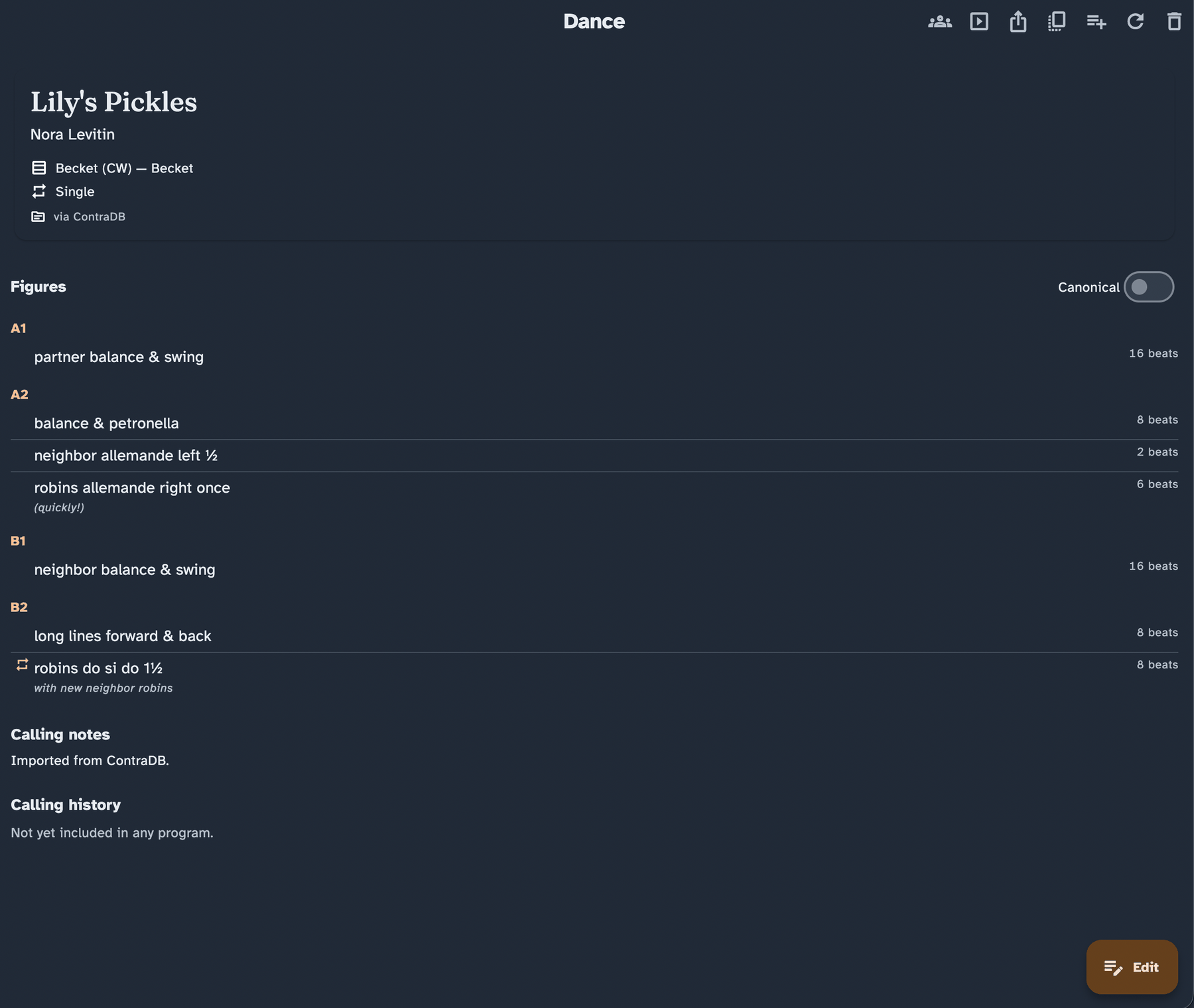
The dance card in the active dialect, with the toggle that switches to shared canonical wording without changing the saved dance.
The dialects that come built in
Caller's Compendium ships with three ready-to-use dialects. You choose one as your active dialect, and you can add as many of your own as you like.
- Larks/Robins — the modern, role-neutral names, and the app's default. If you do nothing, this is what you see.
- Leads/Follows — another role-neutral choice, ready to pick.
- Canonical — the plain, shared wording the app stores underneath (see canonical wording). Handy when you want to see a dance in its neutral form (more on this below).
The built-in dialects are deliberately role-neutral. If your community uses other role names — including traditional gendered ones — you are not stuck: you enter whatever wording you want yourself, in a custom dialect. The next sections show how.
Choose your dialect
- Open Settings and choose the Dialect section.
- In the Dialects list, select the one you want to use. The app switches to it right away, everywhere.
The built-in dialects carry a Preset badge and are read-only, so you can't change their wording by accident. Your own dialects appear in the same list and can be edited freely.
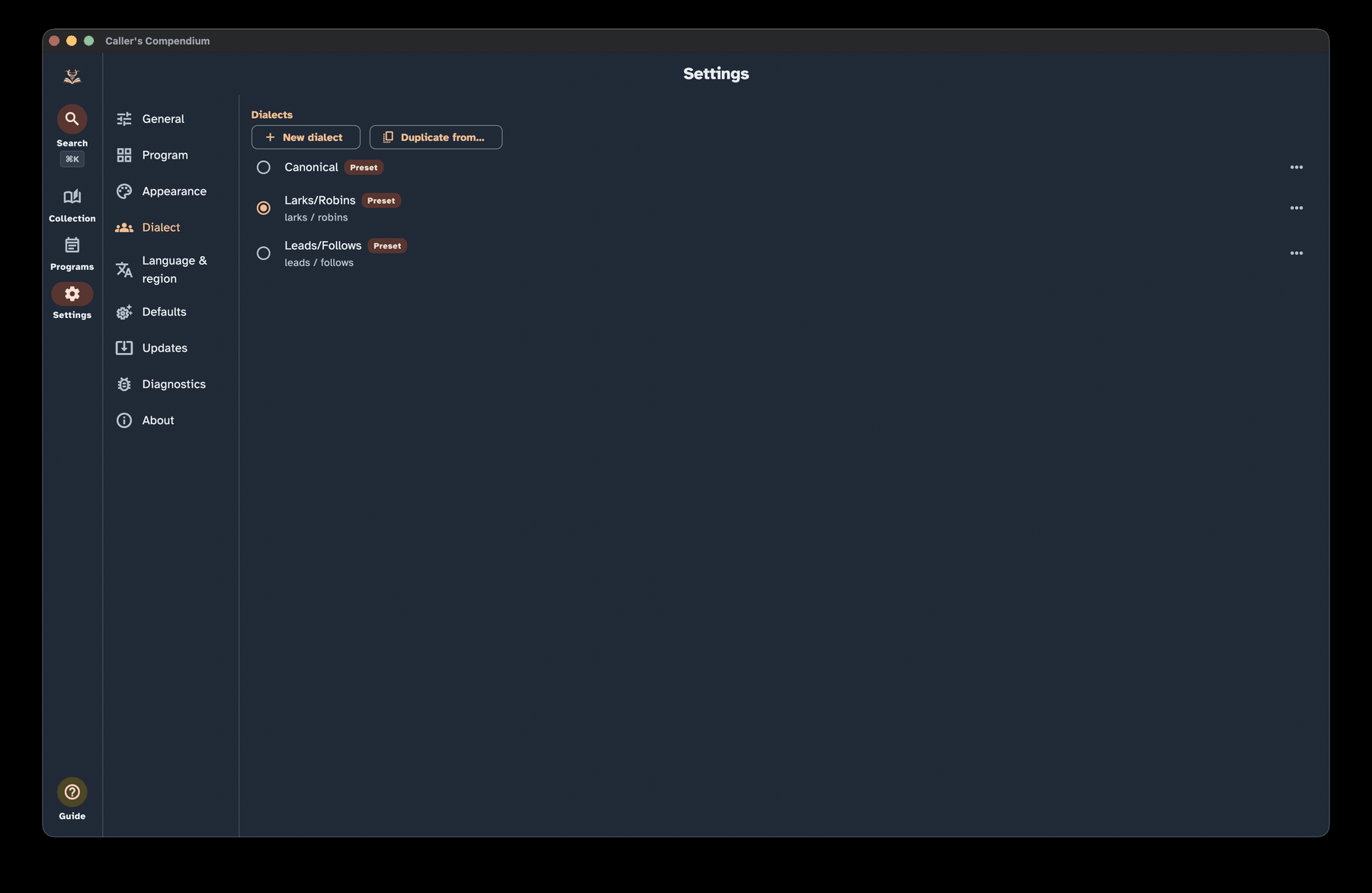
The Dialect section manages the active dialect and the wording of your own custom dialects.
Make your own dialect
When none of the built-in dialects match your community, make your own. From Settings › Dialect:
- Choose New dialect to start from a clean slate. The app asks for a name, then opens the dialect's editor.
- Choose Duplicate from… to copy an existing dialect (a preset or one of your own). The copy is named after the original with "(copy)" added; open its Dialect actions menu and choose Edit terms to change its wording, or Rename to give it a name of its own.
- To tweak a built-in dialect in one step, choose Duplicate to customize from its Dialect actions menu. This makes an editable copy, opens it in the editor, and leaves the original preset untouched.
The editor has a section for each of the following. The Preview section shows sample figures reworded with your dialect and updates as you type, so you can see the effect immediately. Choose Save when you are done.
Role names
In the Role terms section, set the words for the two roles — for example Larks and Robins, or your community's own terms. You can enter both the singular and plural forms; leave the plural blank and the app works it out for you. This is also where you would enter traditional or gendered role names if that is what your dancers use.
Reworded moves
In the Move substitutions section, give individual moves the wording you say out loud. If you always call a move by a particular name, set it here and the app uses your wording on every dance that contains that move. For moves that come in left- and right-handed versions, type %S where the side belongs — for example %S shoulder round — and the app fills in "left" or "right" for you, so you don't have to write two versions.
Move wording templates
To reword the whole sentence around a move, not just its name, add a Display template in the Move wording templates section. Type your sentence and put slots such as {who} and {move} where the app should fill in the details; the editor lists the Available slots for each move and shows a preview. A template can be up to 512 characters.
- If a template leaves out one of its available slots, the editor asks you to confirm before saving, because that detail won't appear on the dance.
- Some slots hide themselves when they add nothing. For example, a chain's
{hand}is left out when the role already implies it (a robins chain is right-hand). Put a!in front of the slot, as in{!hand}, and it always shows. A!slot can't show a detail the figure doesn't have, and a few move-specific slots (such as{subject}or{balance}) ignore the!. - If a template can't be read — a slot left unclosed, for example — the editor says so, and you need to fix it before you can save the dialect.
A few moves are worded differently depending on how they are danced, so the editor gives them a separate template for each version:
- Form a long wave has one template each for In only, Out only, In and out, and Neither.
- Promenade has one for Ordinary and one for Single file.
Fill in only the versions you want to reword; any you leave blank keep the normal wording. A version you do fill in must use every slot the editor lists for it before you can save, so a dancer's in or out instruction, or a single-file promenade, never quietly disappears. A circle uses one template for both forms, and the app adds "single file" for you when a circle is danced that way.
If you made a long-wave or promenade template before the app split them into versions, it still applies — but only to the ordinary version (In only for a long wave, Ordinary for a promenade).
Dancer wording
In the Dancer substitutions section, reword the way the app refers to who is dancing — for example the words for "neighbors" or "the next couple" — to match how you phrase things from the stage.
Discouraged terms
Each dialect keeps a list of discouraged terms — words you would rather not use. When you type one of these while writing a dance, the editor flags it (it shows the word struck through) so you can reconsider, but it never blocks you or changes your text. The list starts with some common examples and is yours to edit, add to, or clear; Restore defaults brings back the starting list.
Separately, the app updates a fixed set of common older terms whenever it shows you a dance: "gypsy" and "gyre" read as "shoulder round", and older role words such as "gents", "ladies", and "ravens" read as your dialect's role names. This applies to dance details (including formation notes, tunes, and custom-field values), shorthands, Perform mode, and text and PDF exports. Titles always show exactly as written. Editing your discouraged-terms list doesn't change which words are converted.
This conversion is on by default. To see the words exactly as they were saved, turn off Auto-convert all discouraged terms in Settings › Dialect › Dance details & shorthands. Either way, it only changes what you see: your saved dances, notes, search, shared files, and backups are never altered.
The app watches for clashes. If two different things would end up with the exact same wording, the editor warns you right away, because that would make it impossible to tell them apart later. Adjust one of the words and the warning clears. You can't save a dialect with an unresolved clash.
Switch dialect on the fly
You don't have to visit Settings every time. On the dance card and in Perform mode there is a Switch dialect control — a group-of-people icon — that changes your active dialect instantly. On a narrow screen the dance card lists your dialects in its More actions menu instead.
Choose it, pick a dialect from the list, and the whole app switches to those words at once. This is built for real evenings: guest-calling for a community that uses different role names, or switching wording between gigs, takes a moment and leaves every saved dance exactly as it was.
Remember the distinction: Switch dialect changes how dances read for you, not the dances themselves. Switch as often as you like.
Give a program its own dialect
If you already know tonight's hall uses a particular dialect, you can set it on the program ahead of time instead of switching on the night. Open the program's details and choose a dialect under Perform dialect; choose Use app dialect to clear it again. The list only offers the dialects you have, so there is nothing to type.
- The program's dialect applies only in that program's Perform mode. The program editor, the summary, and every export keep reading in your active dialect, and your active dialect itself never changes. Other programs are unaffected.
- You can still use Switch dialect in Perform. While the program has its own dialect, that switch affects the rest of this time in Perform only; the program's dialect is back the next time you open it.
- A program remembers the dialect by its name. If you rename or delete that dialect, the program quietly goes back to using your active dialect in Perform, and the editor shows the old name as unavailable so you can see what happened. Pick a dialect again to reconnect it.
Peek at the canonical wording
Sometimes you want to see a dance in the plain, shared wording — to compare notes with another caller, or to double-check what a figure really is underneath your own phrasing.
On the dance card, the Canonical switch (read out by screen readers as Show canonical terms) flips the current view between your dialect and the shared canonical wording. It appears only after you turn on Canonical figure text in Settings › Dialect › Dance details & shorthands; while that setting is off, dance details stay in your active dialect. The switch changes only what is on screen right then — it doesn't change your active dialect or touch the saved dance. When your active dialect is already Canonical, the switch isn't shown, because there would be nothing to switch between.
Perform mode has its own Show canonical terms control, which doesn't depend on the Canonical figure text setting. You can call from your own words and, if a dancer or another caller asks, flip to the canonical wording for a moment without losing your place. See the Perform mode guide for the full calling view.
Set your defaults
These settings decide what you see before you touch anything:
- Your active dialect (in Settings › Dialect) is the wording every screen uses by default — except Perform mode for a program that has its own dialect (see Give a program its own dialect).
The rest are in Settings › Dialect › Dance details & shorthands:
- Canonical figure text controls whether dance details can show canonical wording at all. It is off by default.
- Auto-convert all discouraged terms controls whether common older terms are shown in current wording, as described under Discouraged terms. It is on by default.
- Open dance details in canonical terms decides whether a dance opens showing your dialect or the canonical wording. It takes effect only while Canonical figure text is on; while that is off, dances open in your active dialect and the app remembers this choice for later.
If an earlier version of the app was set to open dances in canonical terms, that choice was reset to your active dialect when Canonical figure text arrived. To get it back, turn on Canonical figure text, then Open dance details in canonical terms.
For a full tour of everything under Settings, see the Settings guide.
Practical scenarios
Guest-calling for another community. You usually call Larks/Robins, but tonight's crowd says Leads/Follows. Before you start, open Switch dialect on the dance card or in Perform and choose Leads/Follows. Every dance now reads in that community's words. Afterwards, switch back — none of your dances changed.
Your community's own words. Your dancers use role names that aren't built in. Make a custom dialect once (Settings › Dialect › New dialect), enter your role names and any moves you say differently, and set it active. From then on the whole app speaks your language.
Bringing in dances written in older words. When you import dances, they may use terms that have since fallen out of use. The app understands the common older words and matches them to the shared form, so those dances still appear in your dialect and still turn up in search — no clean-up required.
Comparing a figure with another caller. Mid-conversation, flip the Canonical switch on the dance card to read the dance in neutral wording you both recognise, then flip back to your own.
Good to know
- Printing and sharing. Text you copy or share, and a PDF you print, are written in your active dialect, so what you hand someone matches how you speak. The on-screen Canonical switch changes only what you are looking at — it doesn't change what an export contains. To export in different words, switch your active dialect first. A dance file you send to another Caller's Compendium user carries the dance itself, so it opens in their dialect. See Share, print & export.
- Screen readers. The app reads dances aloud in your dialect too — your own words are the clearest ones for you — so the spoken view and the visible view stay in step. See the accessibility guide for more.
- It stays on your device. Your dialects are stored on your device, and there is no account. If you turn on the experimental Device Sync, your own dialects and your choice of active dialect sync to your other connected devices along with your library.
Where to go next
- Getting started — find your way around the app.
- Perform mode — call live, with the dialect and canonical controls close at hand.
- Settings — where the dialect manager and display defaults live.
- Collection & search — searching works whatever dialect you use.
- Imports & migration — bring in dances written in other words.
- Share, print & export — which words leave the app with a dance.
- Glossary — plain definitions of the terms used here.