
Write & edit dances
Sooner or later you will want to put a dance in yourself — a dance you wrote, one a friend taught you at a festival, or one that came in from an import with a figure the app could not quite read. This guide covers the dance editor: how figures go in, where the notes and credits live, and how the app keeps your work safe while you type.
Finding your way around these words. On-screen buttons and screens are written in bold — like New dance, Save, and Figures. The first time a dance term appears it links to the Glossary, so you can get a plain-language definition without losing your place.
If you have not entered a dance before, the Getting started guide walks through one end to end. This guide is the fuller reference.
Open the editor
There are three ways in:
- New dance, from your collection — starts a blank dance. The screen is titled New dance.
- Edit, from a dance's detail view — opens that dance. The screen is titled Edit dance.
- Import and edit, on a row in the import review list — brings that one dance in straight away and opens it, so you can fix a stubborn figure while the rest of the import waits for you. It is not covered by the import's Undo.
The editor is a full screen with Save in the corner. The title is the only required field; everything else can stay empty until you know it.
Enter the figures
Figures is the heart of the editor. Each figure is one row, in the order the dance is called, and the app tracks how many beats they add up to as you go.
Type and press Enter
Figure entry is keyboard-first. Choose Add figure (or Add first figure on an empty dance) and type into Type a figure. As the app recognises what you are typing it offers matching moves; press Enter to accept one and it is added with that move's default settings. Typing sw and pressing Enter, for example, gives you a swing.
Anything the app cannot recognise is still kept — it becomes a custom figure, holding your text. Nothing you type is ever thrown away because the app did not understand it; the only change is that role words are saved as role terms and shown in your own dialect (see below).
The dance editor while entering figures, with recognized rows and the running beat total visible below the list.
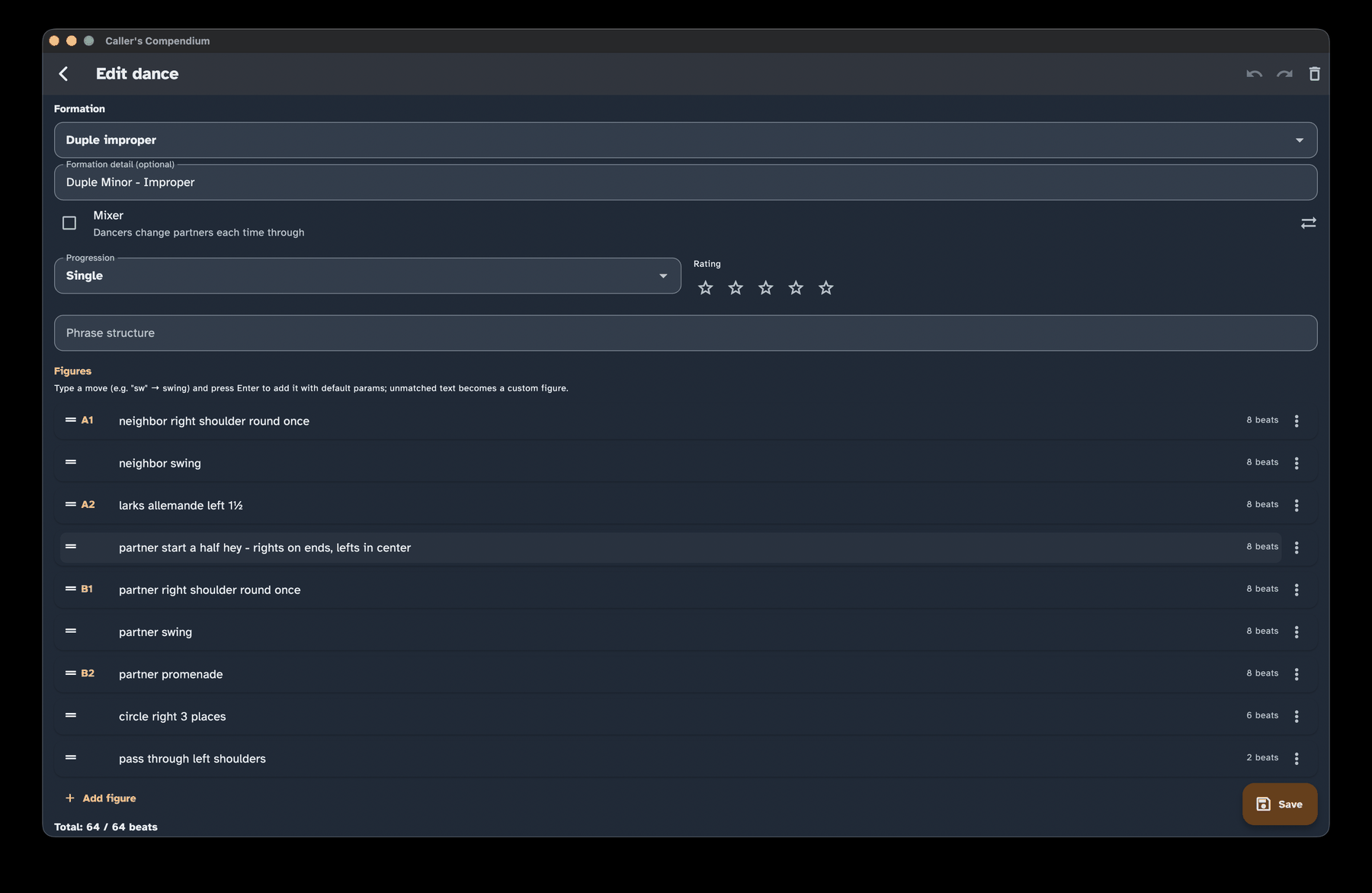
The box stays open after each figure so you can keep going: type, Enter, type, Enter. Press Escape when you are done.
Free-text entry
Turn on Free-text entry in Settings ▸ Dialect ▸ Dance details & shorthands and the same box accepts a whole line at a time instead of one move at a time. Type neighbor balance & swing and you get both figures; type 16 circle left 3/4 and you get a sixteen-beat circle left three-quarters. The app tells you how many figures it added and invites you to type another.
It also understands common phrasings such as N swing, neighbours balance and swing, half hey, ladies start by the right and allemande left 1 1/2 with neighbor. A line whose leftover is only another move, and back or a bare number (neighbors swing 16) is kept as a custom figure, marked unparsed, rather than becoming a figure with the wrong beats; use the leading 16 neighbors swing form to set the beats. give and take still needs a giver and a target.
As always, anything it cannot parse is kept as a custom figure rather than dropped.
Figure shorthands
If you type the same run of figures over and over, teach it to the app once as a shorthand. Choose Figure shorthands in Settings ▸ Dialect ▸ Dance details & shorthands, then New shorthand:
- Shorthand is the exact line you will type during free-text entry. It is matched without regard to capitals, so
NBSandnbsare the same shorthand. - Expands to is the figure or figures it inserts, in order. You build them exactly the way you build a normal figure, with the same options and the same checks.
Shorthands are your own; each one has to be unique, and the app tells you if you reuse a token that is already taken. Shorthands only apply while Free-text entry is on.
Adjust a figure
Select a figure to open it. What you can change depends on the move:
- Parameters — most moves have a few (which role, how far, which way round). Common ones show straight away; choose More options to see the rest, and Fewer options to fold them back.
- Beats — every figure has a beat count you can raise or lower.
- Progression — mark the figure the dance progresses on. Moves that can carry the progression say so.
- Add note — a short note attached to that figure alone.
A figure whose move this version of the app does not know — one added by a newer version, for example — is shown read-only, with a plain explanation. Its data is kept untouched, it edits normally again once the app knows the move, and you can still reorder and delete it in the meantime.
Custom figure
A custom figure has two fields: Custom figure text and Beats.
The Beats field sets how many beats the custom figure occupies — use it the same way you would for any other figure.
The Custom figure text field also accepts two formatting marks, with buttons for both:
*text*for bold_text_for underline
As you type, the app styles what it recognises: move names get a dotted underline, role terms are underlined, and discouraged terms are struck through. The styling is only a hint: it does not change your text while you type. Role words are rewritten when you save, as described next.
Role words you type here (such as "Larks" or "Leads") are saved in a neutral form, shown in your own dialect, and found by role searches. They come back in lower case: "Larks chain wide" shows as "larks chain wide", and "LADIES chain" shows as "robins chain" under Larks and Robins. Custom text saved before this change updates the next time you save the dance while the same dialect is active; text typed in a different dialect may need a manual edit. The same rewriting applies to the everyday words "man", "men", "lady" and "ladies" inside custom figure text (for example, "the man and lady swing"), which are saved as role terms and shown in your dialect's words. Words that are also move words are not turned into role terms, here and in figure notes. The move name "mad robin" is kept as the move name and saved in lower case, so "Mad Robin twice" comes back as "mad robin twice". If your dialect uses Leads and Follows, "lead" and "follow" used as verbs ("Ones lead down the hall", "follow your partner up the hall") are kept exactly as you typed them. "Leads chain" and "the lead on the left" still use the role. Text saved by an earlier version is not repaired automatically.
Reorder, cut, and duplicate
Each figure row has a drag handle and an actions menu:
| Action | What it does |
|---|---|
| Move up / Move down | Shifts the figure one place |
| Cut | Lifts the figure out, ready to place elsewhere |
| Duplicate | Adds an identical figure |
| Group with next as meanwhile | Joins it to the next figure as simultaneous action |
| Group with next as modifier | Makes the first figure the core and the next figure a modifier |
| Mark progression / Clear progression | Sets or clears the progression |
| Delete | Removes the figure |
After Cut, a banner names the figure that is waiting and Paste here points appear between the rows — before the first figure, after any figure, and at the end of the list — so you can drop it exactly where you want. Every move, duplication, and deletion is announced for screen readers, and deletions can be undone.
Meanwhile figures
Some dances have two things happening at once — the ones on the ends do one thing while the middles do another. Choose Group with next as meanwhile and the two figures become a meanwhile group, labelled with how many sides it has and sharing one set of beats.
You can also choose Add meanwhile from the list's Add menu to create the group first. It starts with your Meanwhile defaults (see Start new dances the way you work), or two stand-still sides if you have not set any. If you have cleared those defaults you get two blank sides, and a single default side is paired with one blank one. The group is saved with the dance once at least two of its sides are filled in.
Inside the group, each side is labelled Side 1, Side 2, and so on, and has its own controls to move up, move down, or Remove this side. Add side adds another side, up to six.
Modifier figures
Use Group with next as modifier when one figure describes the main action and the next describes how it is performed. The first figure is labelled Core and the figures after it Modifier, in order. Add modifier creates a modifier group from your Modifier defaults.
You can put a meanwhile group inside a modifier group, or a modifier group inside a meanwhile group, one level deep. The app does not allow a group inside another of the same kind, or nesting any deeper.
Keep an eye on the beats
Under the figure list the app shows a running Total against what the dance's phrase structure expects, and says Over by or Under by when the two disagree. It is a nudge, not a rule — you can save a dance whose beats do not add up, and sometimes that is the honest transcription.
Details, notes, and credits
Details
- Title — required.
- Authors — the choreographer or choreographers. Type to find an existing author or create a new one.
- Type — Contra, English (ECD), or Square. It sets the icon on the dance's row in your collection and what the Type filter finds. A new dance starts with your default type (see Start new dances the way you work); change it here for any one dance.
- Formation and Formation detail — the shape the dance is danced in, plus anything worth adding in words.
- Mixer — tick this when the dance is a mixer: one where you change partners each time through. It's kept separate from the formation, because a mixer can be danced in many shapes and not every circle is a mixer.
- Phrase structure — leave it blank for the standard A1 A2 B1 B2, or write your own (the field suggests
6*8*2as an example). The app checks that what you write is a valid structure, and uses it for the beat count above.
Notes
- Calling notes — how you call it, what to watch for.
- Hook — one line on why you would call this dance.
- Walkthrough — the step-by-step teach.
Walkthrough
You can write the walkthrough as free prose, or build it from your figures.
Each figure can carry an Add walkthrough step description. What you write there is saved as your default for that figure and reused wherever it appears — so the way you teach a hey is written once and follows you into every dance with a hey.
Two things follow from that:
- Fill from snippets assembles a walkthrough from the saved snippets of the dance's figures. If it would overwrite something, the app asks first. If none of the figures has a snippet yet, it says so rather than emptying the field.
- If you edit a step so it no longer matches your saved snippet, the app asks Update your saved snippet? — choose Use everywhere to update the default, or Just this dance to keep the change local.
Your whole library of snippets lives at Settings ▸ Dialect ▸ Dance details & shorthands ▸ Walkthrough snippets, where you can review and edit them. Editing one there updates the default used everywhere.
More details
More details expands to everything else a dance can carry:
| Field | Notes |
|---|---|
| Level and Status | How hard it is, and where it is in your workflow |
| Mixed level | For dances that span the difficulty scale |
| Rating | Your own star rating, with Clear rating to unset it |
| Composed / Revised | A year, optionally with a month and day |
| Tags | Your own labels |
| Tunes | Tunes you like with this dance |
| Links | A URL with an optional label, marked Source, Video, or Other |
| Published sources | Citations, with optional page and number |
| Related dances | Cross-references to other dances, each with an optional note |
| Custom fields | Any custom fields you have defined — see Collection & search |
To tie a whole family of dances together — several variations of one dance, say — turn on Include in related-dance group for the link. Every dance in the group is then linked to every other one. Removing a group link breaks up that whole group, while ordinary related-dance links are left alone.
If the editor spots wording it considers discouraged, it collects it under Warnings with the term named. Nothing is blocked; it is there so you can decide.
Author and source details are shared
Choose to edit an author's details and you get Choreographer details — name, website, email, location, notes, and whether they are deceased. The dialog is explicit about two things, and both matter:
- These details are shared across every dance credited to that author, so correcting a spelling here corrects it everywhere.
- Email and location are private, and so is the deceased mark. They are stored only on this device and are never shared or exported. See Share, print & export for exactly what leaves the app.
Source details works the same way: a source's details are shared across every dance that cites it, and editing them here updates the source everywhere it is referenced.
Undo, drafts, and saving
Undo and redo
Undo and Redo sit in the editor's top bar, with keyboard shortcuts:
| Action | Linux / Windows | macOS |
|---|---|---|
| Undo | Ctrl-Z | Cmd-Z |
| Redo | Ctrl-Shift-Z or Ctrl-Y | Cmd-Shift-Z |
Your work is kept while you type
The editor keeps a draft as you work. If the app closes before you save — a crash, a flat battery, a phone that decides to reboot — the next time you open that dance the app offers you the draft back:
Unsaved draft — You have an unsaved draft for this dance. Would you like to restore it?
Choose Restore to pick up where you left off, or Discard to start from the last saved version. Drafts stay on your device; they are never uploaded, shared, or included in exports.
Leaving without saving
If you try to leave with unsaved changes, the app asks Discard changes? — Keep editing returns you to the dance, Discard leaves it as it was last saved.
Save and delete
Save writes the dance and returns you to where you came from; the change shows in your collection straight away. If a save fails, the app says so and leaves your work in the editor so you can try again.
Delete dance (in the top bar, on an existing dance) removes the dance. As everywhere else in the app, deletion is a soft delete with an Undo offered right away — see Keep your collection tidy.
Start new dances the way you work
If most of your dances share a shape, set that shape once. Settings ▸ Defaults ▸ Dance-authoring defaults decides what a New dance starts as:
- Type, Formation, and Progression — what a new dance begins with.
- Default phrase structure — seeded into new dances; blank means the standard 4×16 (A1 A2 B1 B2).
- Starting figures — the figures a new dance starts with. It defaults to a single stand still of eight beats; clear it for a completely blank dance.
- Meanwhile defaults and Modifier defaults — the figures a new meanwhile or modifier group starts with.
- Move defaults — your preferred parameter values, applied whenever you insert that move. These override the move's built-in defaults, and you can still change any parameter on the figure afterwards.
- Aggressively recompute figure beats — off by default, so a beat count you typed yourself is left alone, except that switching a balance option on or off adds or removes 4 beats. Turn it on and changing a figure's move, or an option that affects its timing, recalculates its beats straight away, even over a count you typed.
Every one of these is only a starting point; you can change any of them on any dance.
Fix figures an import could not read
Imported dances sometimes arrive with figures kept as plain custom text because the app could not recognise them at the time. As the app's figure recognition improves, those can often be upgraded.
In Settings ▸ General ▸ Import, find Re-check custom figures and choose Re-check…. The app scans your collection and shows you what it could upgrade before anything changes: how many figures, in how many dances, and which ones. You confirm, and only then does anything happen.
Your tags, ratings, notes, and everything else on each dance are kept exactly as they are — only figures that now recognise a known move are replaced. If there is nothing to upgrade, the app tells you that and leaves your collection alone.
A dance whose stored figures the app cannot read at all is left out of the scan rather than upgraded, and its stored text is not touched. The dance's own page tells you when its figures cannot be read.
Where to go next
- Find and organize what you have entered: Collection & search
- Bring dances in rather than typing them: Imports & migration
- Put figures into your own words: Dialect
- Build an evening from your dances: Programs & matrix
- Hand a dance to someone else: Share, print & export
- Using assistive technology or large text? The Accessibility guide covers screen readers, text size, high contrast, and keyboard use.
Not sure what a word means? The Glossary has plain definitions for every term used across these guides.